published
Sept 30, 2010
112 pages
The theme of this special issue generated massive response among KJ contributors. We added extra pages to the print magazine distributed at COP10, and posted an additional 35 other articles on KJ’s website, downloadable as PDFs. They remain available here:
KJ 75 Special Online Features
sampler

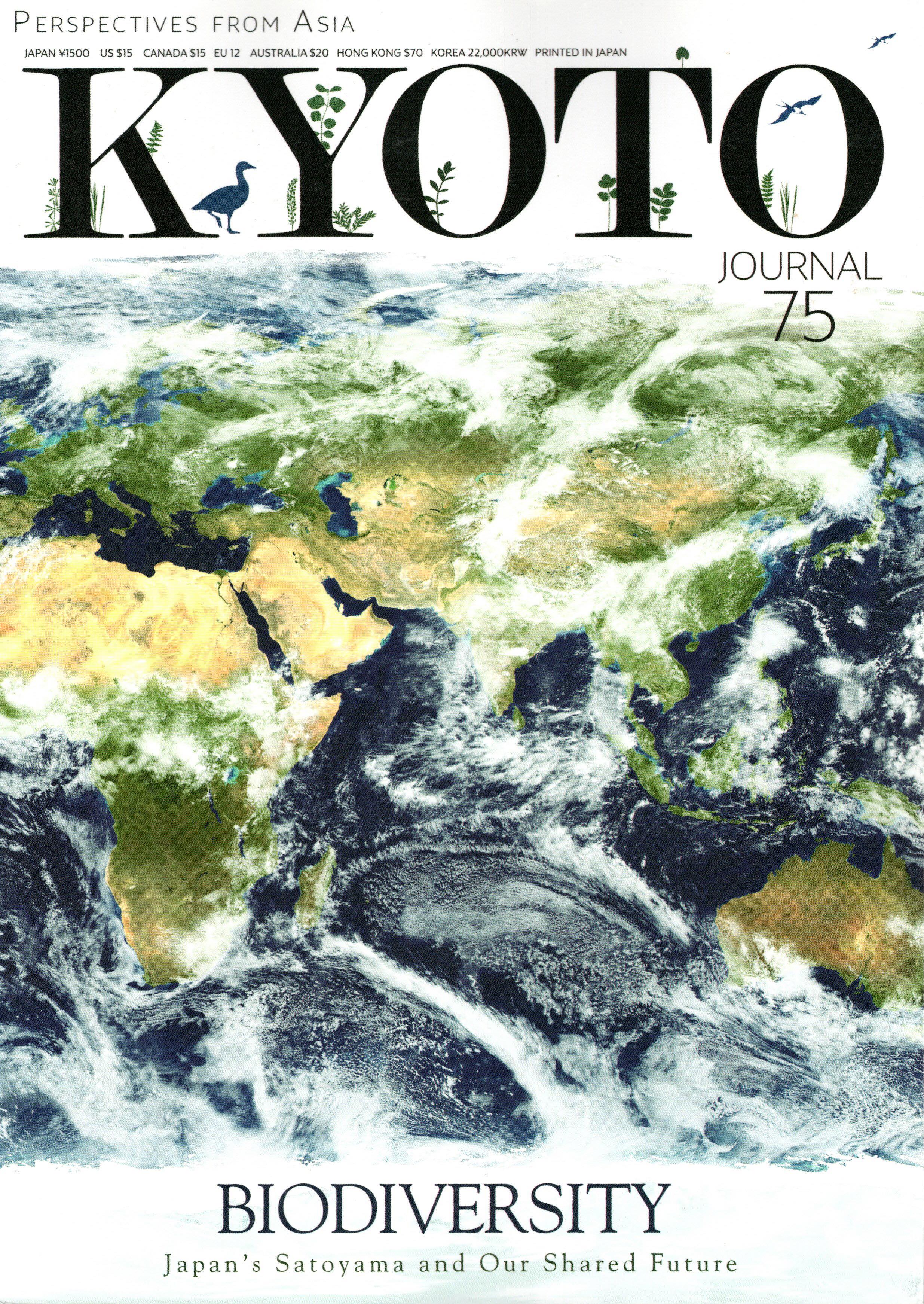
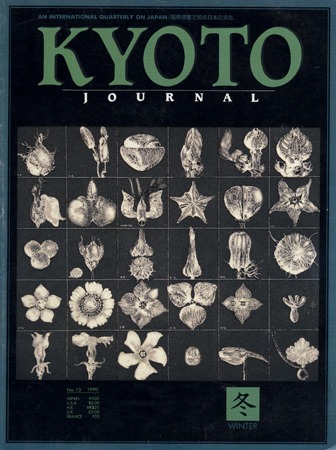
KJ 75, BIODIVERSITY: This richly informative and lavishly illustrated special issue, edited by Stewart Wachs and designed by John Einarsen, features wide-ranging contributions by more than 50 writers, photographers and artists, specially prepared for distribution in fall 2010 at COP10 in Nagoya, the UN’s 10th Conference of Parties to the Convention of Biological Diversity (CBD). An extensive 22-page section explores the ideal – and troubling present-day reality – of Japan’s satoyama: rural areas where people have lived with the land and on it without spoiling it over many generations, preserving and even promoting biodiversity. Plus over 30 additional diverse exclusive online reports — all downloadable.
Contents
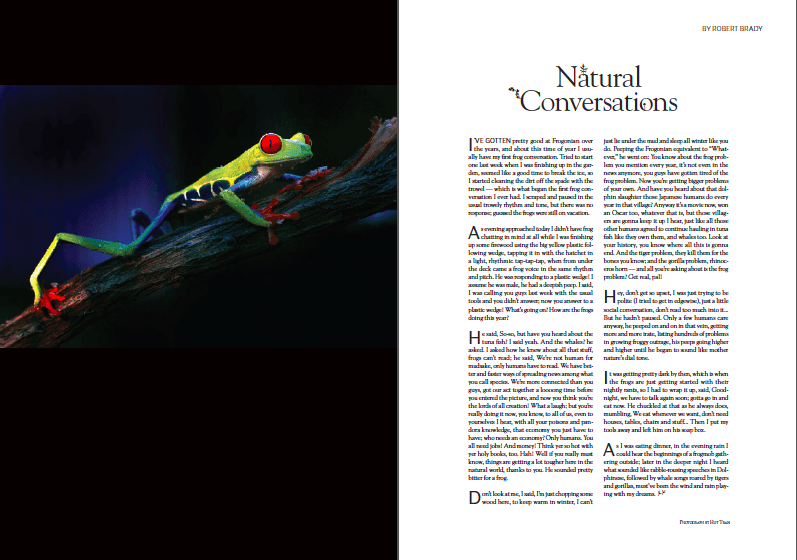
I’ve gotten pretty good at Frogonian over the years, and about this time of year I usually have my first frog conversation.
In sum, the biosphere is being collectively ravaged by huge corporate bodies protected by purchased politics and united in their hostility to growth limits and environmental costs. Equally grim, biodiversity’s last line of defense is manned by scattered environmental forces too divided by their issues to devise joint battle plans and discover their true strength.
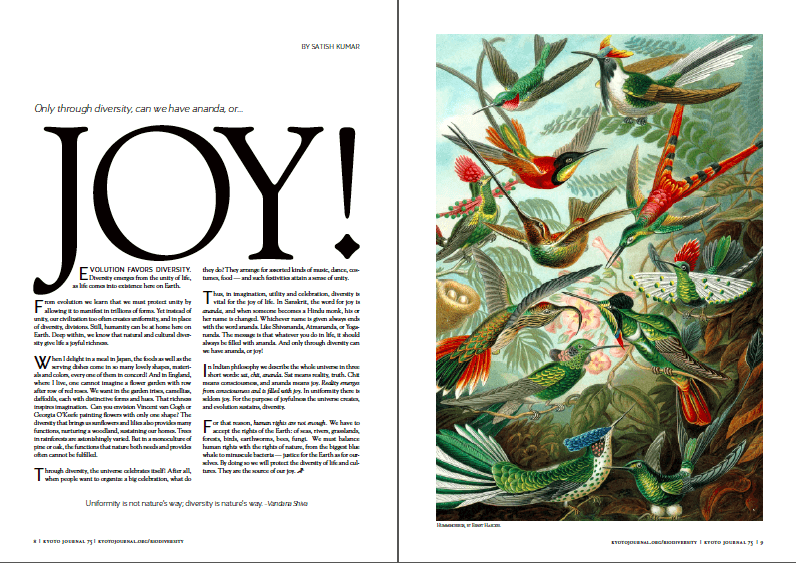
From evolution we learn that we must protect unity by allowing it to manifest in trillions of forms. Yet instead of unity, our civilization too often creates uniformity, and in place of diversity, divisions.
Over the years, in speaking with Eskimo people — Yup’ik and Inupiat in Alaska and Inuit in Canada — I came to understand that they prefer to avoid the way we use collective nouns in the West to speak about a species.
The Big 5 refers to five — and only five — extremely unusual times in the past 550 million years. Times when at least 75% of Earth’s species went extinct in a geological instant.
Carry this magazine outside, open to this page. Step off your front porch, or stoop, or whatever you have, and look around. What do you see?
The plants and animals in this picture have gone to the brink of extinction and been carefully husbanded back, or were presumed extinct and then re-found.
Delegates, when you arrive in Nagoya, Japan this October for the UN’s 10th conference on biodiversity, you’ll be meeting at a decisive moment. For the agreements you reach, or fail to, at COP10 may well determine whether many forms of life survive or die out — including the large-brained, spiritually-inclined but as yet self-defeating, tool-making ape — a relative newcomer to this biodiverse world.
The MA’s findings, contained in five technical volumes and six synthesis reports, provide a state-of-the-art scientific appraisal of the condition and trends in the world’s ecosystems and the services they provide, and the options to restore, conserve or enhance the sustainable use of ecosystems.
An economist wrote that some things have a huge value, but they’re not very useful — a diamond, for example — and that other things are very useful, such as water, but they don’t seem to have a very high value. What he was really saying is that human beings have neither addressed the nature of value nor indeed the value of nature.
The Cenozoic period is being terminated by a massive extinction of living forms that is taking place on a scale equaled only by the extinctions that took place at the end of the Paleozoic around 220 million years ago and at the end of the Mesozoic some 65 million years ago.
Even as new discoveries are being made about these underwater forests and grasslands, they are rapidly vanishing. Seaweeds are extremely sensitive to changes in water temperature, rendering them vulnerable to global warming.
Scientific tools and conceptions built to work well in controlled engineering contexts — involving simple and stable clockwork mechanical devices — do not work well in natural systems, where nonlinear instability is literally a fact of life.
Unless and until we have discovered and described a preponderance of Earth’s species, our knowledge of biodiversity will remain inadequate to meet the challenges of our rapidly changing planet.
Forty-two percent of UK respondents in a recent Gallup poll had never heard of biodiversity. Only 27 percent knew what it meant. Now, either I’m missing something or these are alarming statistics.
Animals, plants, and microbes are the consummate engineers. They have found what works, what is appropriate, and most important, what lasts on Earth.
The biological world with its ecological interactions is this world, our very own world. Thus, ecology (with its root meaning of “household science”) is very close to economics, with its root meaning of “household management.”
Not only do each of us, in our human consciousness, “contain multitudes,” as Walt Whitman put it, but the practice of biodiversity recognizes that we are personally diminished with every species loss.
In Japan, divinities might be of mountain, sea, or river. People find divinities in nature. This religious faith still exists. I think then that we can understand shrines as points in which nature, divinity, and human beings come into contact.
Within prayers to the universe during our rituals, within sacred stories about gods, storytellers and listeners, within the world of myth that storytellers entice you to enter, there is a place to create and cultivate caring and love towards nature. The key to coexistence with other living things lies hidden there.
Fewer than 300 boats in the world are destroying the deep sea, the largest reservoir of biodiversity on Earth. They are wiping off the map deepwater coral reefs and sponge beds thousands of years old.
Humans are part of the planet’s diversity. We are members of the Earth Family ( Vasudhaiv Kutumbakam in Sanskrit) consisting of the diverse species and varieties of microorganisms, plants and animals.
Little did I know that my sister-in-law had a yearning to live in true wildness — not the gluttonous savagery of “wild” financial markets, where she formerly made her living, but the natural wildness which, like the best of civilized culture, reminds us of what it means to be human, of what we are linked to rather than separate from.
Biodiversity, of course, faces an enormous set of challenges in this century, but none so far-reaching as the rapidly rising temperature and all that it implies. Basically, the stable Holocene of the last ten thousand years has come to an end.
In 30 to 60 years, the seven major rivers flowing from the Qinghai Tibetan Plateau and through Asia, nourishing billions of people in ten countries, will alternately flood and experience drought due to rising temperatures and rapid glacial melt.
Within the standard biological division of higher organisms into two distinct kingdoms — plants and animals — mushrooms fall somewhere in between.
The Tiger is in crisis. Once it prowled forests and grasslands stretching to the corners of Asia; today fewer than 4,500 wild tigers remain in just a fraction of their former range.
Up in the tree is a spectacle of mass ripening, mangos in every phase of change, like maple leaves in autumn, turning from dark green to crimson to orange to bananaskin yellow.
If a diverse ecosystem is in good health it will, over time, increase its own diversity. Evolution increases differences. Culture is about accentuating differences.
While many rewilding projects are in their infancy — the European Green Belt, for example, has just begun to restore the former Iron Curtain region as an “ecological backbone” — others have achieved astonishing early results.
The Korean Demilitarized Zone (DMZ) and adjoining Civilian Control Zone (CCZ), both created by the 1953 ceasefire to the Korean War, are a biodiverse oasis providing an important resting area for cranes and other birds during migrations.
One way to grasp the main perspectives of environment and biodiversity is to understand the origins and precious nature of a single living form, a single living manifestation of the miracle of existence: if one has truly understood a crane —or a leaf or a cloud or a frog — one has understood everything.
SPECIAL SECTION: THE WORLDS OF SATOYAMA
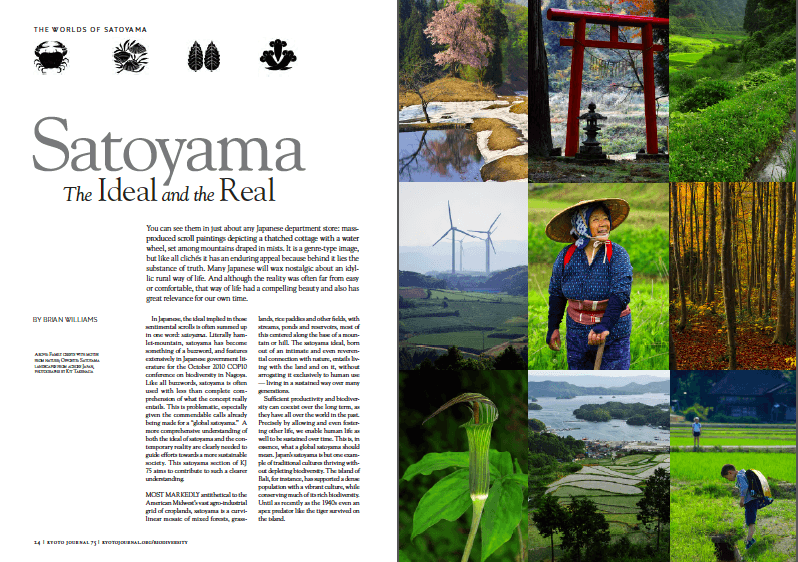
Literally hamlet-mountain, satoyama has become something of a buzzword, and features extensively in Japanese government literature for the October 2010 COP10 conference on biodiversity in Nagoya. Like all buzzwords, satoyama is often used with less than complete comprehension of what the concept really entails. This is problematic, especially given the commendable calls already being made for a “global satoyama.” A more comprehensive understanding of both the ideal of satoyama and the contemporary reality are clearly needed to guide efforts towards a more sustainable society. This satoyama section of KJ 75 aims to contribute to such a clearer understanding.
Satoyama describes a rural Japanese landscape made up mainly of managed woodlands and grasslands, rice fields, and the network of waterways and reservoirs associated with them. Underlying those elements, however, satoyama refers to certain principles of living on the land that belong no more to Japan than to any place long and sustainably cultivated by humans.
Like all else in the satoyama landscape, the satogawa
(literally ‘hamlet-streams’) were adapted over time to suit human needs. This was done in ways that did not diminish biodiversity but allowed it to flourish in the new configurations.
Satoumi juxtaposes “village” and “sea” to describe coastal zones — of seas, estuaries or lakes — that are highly biodiverse and productive, yet far from untouched.
Gradually the remaining farmers have grown too old and too few to continue trimming branches, cutting undergrowth, and thinning the forests as they should.
Valid doubts persist about whether satoyama has ever been fully realized in its ideal form, or whether a national government whose policies helped to destroy the traditional rural environment has any right to turn round and trumpet that network of integrated ecosystems as a model for the world. But becoming snagged in such debates will distract us from the many tangible and inspiring successes attained by these land-use practices themselves.
Just Enough: Lessons in Living Green from Traditional Japan, by Azby Brown — Julian Bamford
SATOYAMA: The Traditional Landscape of Japan, by K. Takeuchi et. al — Carl Bareis
The Deep Ecology Movement: An Introductory Anthology, by edited by Alan Drengson and Yuichi Inoue — Richard Evanoff
Sustaining Life: How Human Health Depends on Biodiversity, by edited by Eric Chivian and Aaron Bernstein — Sanya Samac
Earth Pilgrim: Conversations with Satish Kumar, by Satish Kumar — Ted Taylor
The Forgotten Japanese: Encounters with Rural Life and Folklore , by Miyamoto Tsuneichi, trans. Jeffrey S. Irish — Ken Rodgers
A Different Kind of Luxury: Japanese Lessons in Simple Living and Inner Abundance, by Andy Couturier — Jennifer Chan
The Japanese Tea Garden, by Marc Peter Keane — Stephen Mansfield
The One Straw Revolution: An Introduction to Natural Farming, by by Masanobu Fukuoka, trans. Larry Korn — Kevin Cameron
KJ 75 BIODIVERSITY Online Articles:
Over 400 billion years ago, when our planet first formed, biodiversity was zero. There were no species. No life.
Loss of biodiversity threatens the ecosystems that play a central role in supporting vital Earth systems upon which humanity depends.
Our arts, leisure and entertainment, too, are linked to the myriad shapes, sounds, materials and colors of biodiversity. In short, when we speak of biodiversity we are also talking about the quality of human life and human survival.
“Satoyama” has become something of a buzzword in the last few years, appearing often in the media and discourse on nature conservation and environmental management practices in Japan.
On a beautiful pure blue day just before Christmas, I helped my husband rebuild a crumbled stone retaining wall behind his parents’ house in Mie prefecture.
Nestled somewhere along the Nogawa river in Osawa, Tokyo, is a small rice paddy known as Hotaru No Sato , or “home of the fireflies.” Every summer, sometime in late June, fireflies (hotaru) make this place their home.
Kitayama forestry has been practiced for more than 600 years. This traditional forestry is characterized by dense planting of cedar trees on steep rocky slopes.
Lake Biwa is far and away Japan’s largest lake, stretching more than 63 kilometers from end to end, with a maximum depth of just over 100 meters.
Habitat creation for a fictional character dissolves the borders between science and magic, city and country, pragmatism and aesthetics.
We’re accustomed to thinking of biodiversity in connection with wild species, but the biodiversity of the crop species on which we depend is no less important.
Noguchi Isao, now 65 years old, was born in the seed shop that his grandfather started in Hanno, in rural Saitama, northwest of Tokyo.
Wild-growing genetically-modified (Gm) canola plants have been found at many locations around Japan. The first investigations by concerned citizens started in 2004.
Seeds are travellers in space and time. In many species seeds are shed dry, and the embryos held within remain in a state of suspended animation – not alive, not dead, just waiting for moisture to reawaken them.
The critically endangered Amur, or Far Eastern leopard ( Panthera pardus orientalis) is probably the rarest big cat in the world. A mere 25 to 34 individuals remain in the wild within the southwest Primorye region of Far Eastern Russia.
Its existence has been so magically described, majestically worshipped and globally admired, yet this charismatic creature has been driven to the edge of extinction.
Little things — lizards, beetles, a roosting owl, weaver birds, ground squirrels… A host of tiny lives, so easily unnoticed, but so full of interest once one has become aware of them. And so important to the integrity of the whole ecosystem.
When it comes to big-time biodiversity conservation, Protected Areas (PAs) are a major asset and a key ally. They cover 13 percent of the Earth’s surface and contain the highest concentrations of biodiversity. Strengthening of the PAs is obviously a key strategy.
Thailand’s coral reefs support 4,000 species of fish, 700 species of coral, and thousands of plants and animals — coral reefs are home to one in four marine species.
More than a third of the world’s fisheries have commercially collapsed within the last century, while only a handful have subsequently been restored.
In the fall months abalone divers who operate near these islands describe a feeling of being watched by eyes that lie just beyond their field of view, and some have spent harrowing moments hiding beneath boulders while great whites roamed nearby.
Zero-emissions operation means no oil pollution and no threat of spillage. With Greenheart ships replacing conventional small and medium-size vessels, the lessening of environmental destruction would be immediate and dramatic.
The choice before Jeju is that of an epic struggle — global urbanization, industrialization, and militarization versus natural preservation.
We know that the environment is the social security system for a vast number of poor. Although jobs may be created, they cannot be sustained in a vacuum that does not include solid social, economic and environmental foundations.
We, the international Council of Thirteen Indigenous Grandmothers, represent a global alliance of prayer, education and healing for our Mother earth, all Her inhabitants, and all the children, for the next seven generations to come.
The eco-crisis is as much a spiritual challenge as a technological one.
Seeming to defy gravity, the Buddhist hermitage of Taktsang — long known as the Tiger’s Nest — perches precariously on the face of a cliff three thousand feet above a dense jungle forest.
Any action taken to restore a place’s natural biodiversity can also spark further beneficial changes that will come as a complete surprise.
The flora, fauna, and terrains of our graceful planet contain a whole world of discovery. It only takes a single child and a trip outdoors, to realize that it is arguably our planet’s richest resource of intellectual query.
As humans, I have come to see, we are nested within a system that is infinitely creative; recognizing this truth unleashes our own creativity.
Working in the butterfly exhibit at the Natural History Museum, you hear more kids ask if the butterfly is broken than if it’s dead. Which to me is a pretty big sign that there is something wrong with our basic understanding of the natural world.
This table set is made almost entirely from driftwood. Each salvaged piece has a unique shape, texture, colour, and often other characteristics that suggest a story which could span years or decades.
A CD from the Cornell Lab of Ornithology transports the listener to wild habitats around the world and even turns back the clock to celebrate the sounds of animals. Selected from more than 150,000 recordings in the Lab’s collection, the 62 cuts on The Diversity of Animal Sounds capture the voices and vibrations of animals as they court, fight, find food, and react to predators.