Photographs by Lane Diko
Kyotographie 2026 has launched EDGE, its 13th iteration, having completed the full 12-year cycle of the Chinese zodiac last year and now beginning a new one. Their 2025 book KYOTOGRAPHIE: A Kyoto Story—A Twelve-Year Cycle is both a compendium and biography of the festival, its artists, and co-founders Lucille Reyboz and Yusuke Nakanishi. This year, in commemoration of their achievements, they were named Knights of the Order of Arts and Letters (Chevalier de l’Ordre des Arts et des Lettres) by the French Ministry of Culture.
Each year, Kyotographie brings a flurry of activity to the old capital, filling the city for a month with exhibitions, concerts, parties, talks, and workshops. Like so many spring blossoms, there is too much to see and it is over before we know it. After more than a decade, Kyotographie feels like one of the many annual events that makes Kyoto so special. The festival has settled into a familiar pattern with its own traditions. Forgoing some of the funkier and far-flung locales of earlier years as the festival has grown more and more popular, the established venues near the city center are again transformed and inhabited by a constellation of exhibitions that blur photographic genres—including documentary, journalism, fashion, and high art, and vernacular photography—with particular focus on alternative processes, presentations, and formats. The work of female photographers and African photographers are well represented as usual.
Thandie Muriu — “Camo” and “Inchinyo – More Than Half”
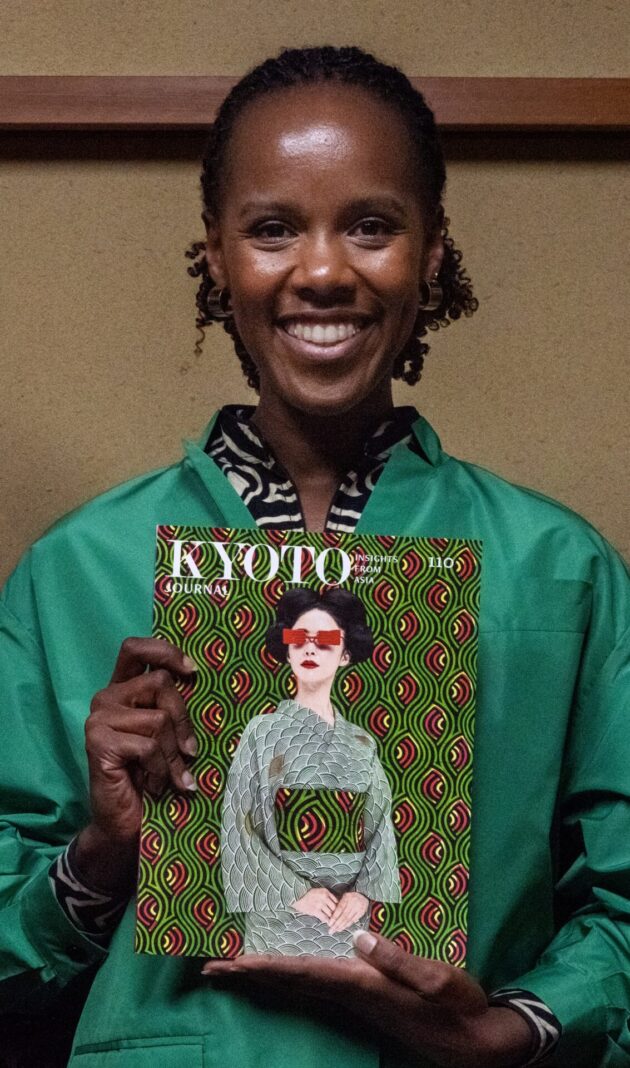
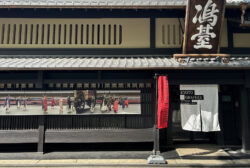
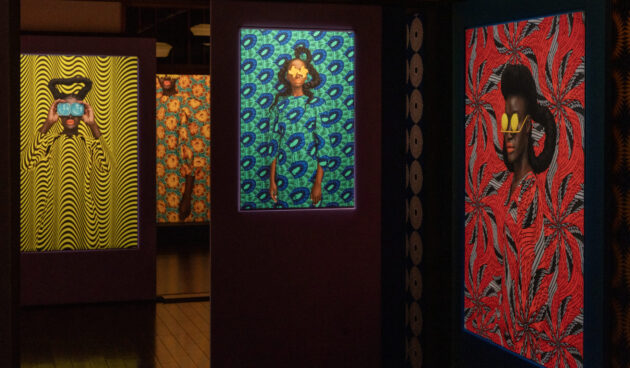
An example of both is Thandiwe Muriu and her dual exhibitions at Kondaya Genbei, the headquarters of the centuries-old obi maker. Murui’s vivid, perception-warping images of African women and textiles are presented elegantly, glowing vibrantly within the darkened spaces of the traditional Japanese building. Muriu’s background in commercial photography is apparent both in the meticulousness and sheer spectacle of the work. Women clothed in African wax fabric are presented against a backdrop of the same patterned material, blending foreground and background into a kind of optical illusion where the human figures seem present and not present in turns. The commentary on female marginalization and gender roles is cleverly conveyed within the eye-catching package. These are not portraits per se as the women themselves function as fashion models, an effect further emphasised by the fact that their eyes are all obscured by accessories; these were made from quotidian household items such as combs, tea-strainers, and pastry brushes. Though her use of saturated colors and everyday commercial objects bring to mind Pop Art references, Murui’s work is more in line with the Op Art tradition, particularly the work of Victor Vasarely and Richard Anuszkiewicz.
The choice of venue is especially apt as an upstairs display of Kondaya Genbei’s obi invites comparisons between the fabric cultures of Japan and Africa. A bridge-like passage through a sunny inner garden leads to “Inchinyo – More Than Half”. As the recipient of the Kyotographie 2025 African Artist Residency Program, Muriu spent time in Kyoto last year, creating a new body of work inspired by her experiences and research in the city. She worked with Kyoto dyers and kimono and obi makers to create new kimono which were then paired with obi made from African wax fabrics. While formally similar to her African images, the Kyoto images also address issues of race, nationality, and cultural identity. Muriu challenges the Japanese term “hafu” (literally “half”), used to describe people of mixed race, by reframing such heritage as one that is both fully Japanese and fully African. The models in this series are Japanese, Black, and “Blasian” (a portmanteau of Black and Asian) with hairstyles that combine Japanese and African elements. Interestingly, the only woman in the series with her eyes uncovered is a young woman with both African and Japanese ancestry, looking serenely and confident out at the viewer.
Muriu’s Kyoto images are additionally displayed on giant hanging banners in the Demachi Masaugata shotengai (shopping arcade) as well in a kakejiku-like format at Kyotographie’s DELTA space. They also grace the cover of Kyoto Journal 110, “Color & Kyoto”. The stunning use of color in her unique synthesization of Kyoto and African cultures was the perfect match the issue.
Ernest Cole — “House of Bondage”
Kyotographie’s lens is international and diverse but rests on a tripod fixed firmly in Japan, France, and Africa. This year, in addition to Thandiwe Muriu’s exhibitions as the KG African Artist Residency recipient, there are several focusing on the art, culture, and politics of South Africa. This continues a tradition of South African photographers exhibiting in Kyotographie, including Zanele Muholi, Gideon Mendel, and Roger Ballen (an American long based in Johannesburg).
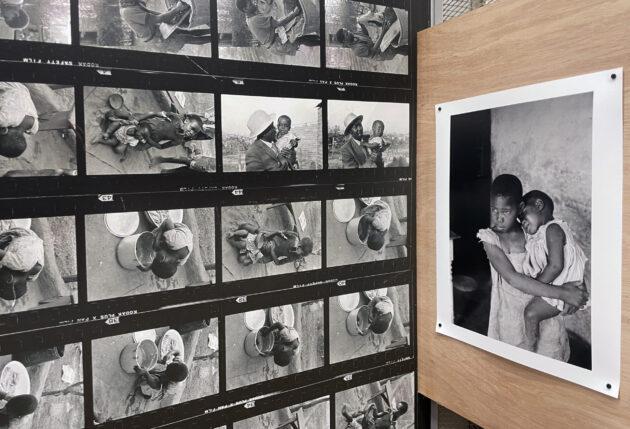
The centerpiece of “South Africa in Focus” is Ernest Cole’s “House of Bondage,” an exhibition of images from the singular photobook masterpiece of the same name which documented the lives of South Africans under Apartheid. Published in 1967, House of Bondage is remarkably vital today in its depiction of the cruelty of Apartheid, the mundanity of its daily implementation, and the humanity and sensitivity with which Cole approached his subjects. In the legal hierarchy of Apartheid each citizen was categorized as either White, Colored, or Black, and as a “Colored” person, Cole was able to travel relatively freely as a photographer, risking his life to systematically photograph the structures of segregation and subjugation. Cole was able to travel to New York, publish his work, and reveal the realities of the South African system to the world, but he was therefore never able to return to his home country.
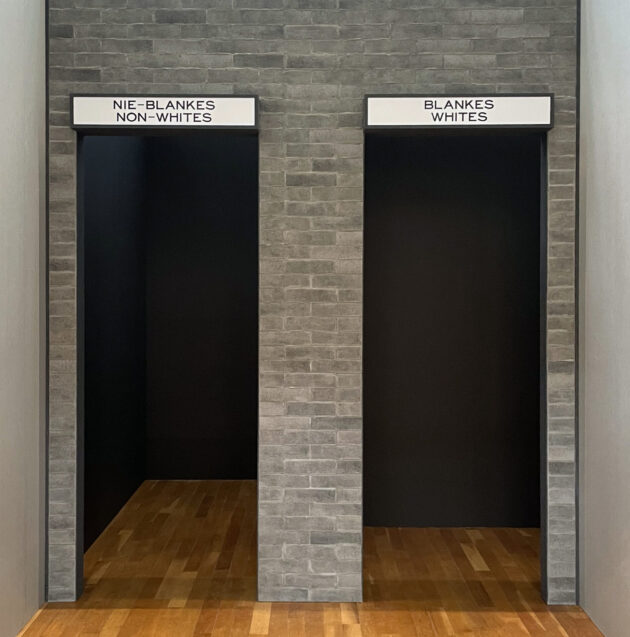
At the entrance to the exhibition are two doors, labeled “Blankes” and “Nie Blankes” (“Whites” and “Non-Whites” in Afrikaans). Viewers are forced to make a choice between the two as they enter, thereby symbolically participating in the fundamental structure of Apartheid, which literally means “separation.” Cole’s title, “Bondage,” implies being constrained, both mentally and physically, not necessarily in a prison but in the normalized, everyday societal structure. The curators have faithfully adhered to the book, laying out the space in small rooms corresponding to each chapter. The presentation is deliberately utilitarian: unframed prints tacked to raw wood boards. Wall-size displays of the photographer’s marked contact prints show each frame he captured.
Lebohang Kganye — “Rehearsal of Memory”
In an intriguing juxtaposition of space with content, “Rehearsal of Memory,” an intimate exhibition by South African artist Lebohang Kganye is held within the grand Higashi Hongan-ji Temple, one of the headquarters of Jodo Shinshu, the largest Buddhist sect in Japan. The relatively modest O-Genkan building is the oldest in the temple, built in 1867 after having been destroyed, along with most of central Kyoto, in the Hamaguri-mon Uprising three years earlier.
Rooted in historical vernacular photography, including her own family photo albums, Kganye’s work employs various forms of collage—digital manipulation, cut-outs, stage scenery, and sewn fabric—to examine and question how families and communities present themselves through photography, how they create family narratives and collective memories, and how that history is subjectively preserved through many small performative acts of self-documentation. Viewers will naturally reflect on how these images from a pre-digital age compare to the infinite profusion of selfies today.
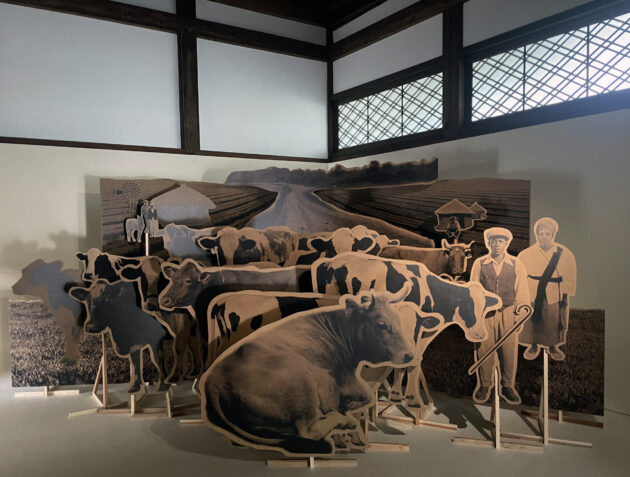
In one series, she restages old family photos and then digitally superimposes herself into them. In these digital collages of past and present, it is unclear which figure is the original and which was added. In another space, timed spotlights intermittently illuminate crowded groups of large cardboard cut-outs of people, farm animals, and household furniture. Each figure in this near life-size diorama has been cut from its original context and haloed by a white margin, which, along with the spotlights, creates the impression of stage play or children’s storybook. The next small room holds a collection of literal dioramas, small lightboxes containing scenes of seascapes, lighthouses, fisherfolk, and graves. These little narratives seem less personal than the other series, suggesting scenes from fables that form a larger, enigmatic narrative. After the life-size and miniature presentations, giant figures fill the final room. In a tall, circular space, floor-to-ceiling tapestries display individuals against white, removed again from their original contexts. Based on historical photographs, these well-dressed, self-possessed figures have been quilted together from hundreds of scraps of fabric. They suggest the performative nature of portraiture (for both photographer and model), and the putting on of one’s Sunday best, in this case both literally and figuratively.
Pieter Hugo — “What The Light Falls On”
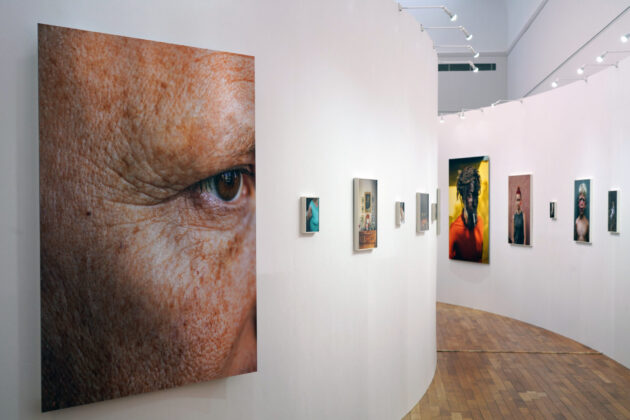
Pieter Hugo, one of South Africa’s most prominent photographers, is known for his striking, remarkable portraits. At the Kyocera Museum he offers a tame jumble of still-lifes, portraits, and landscapes. “What The Light Falls On” gathers photographs taken around the globe in various professional and personal contexts before the project was conceived under the vague yet grandiose theme of “birth, death, and the rites between.” Acknowledging, and indulging in, the hodge-podge nature of the series, the images are presented in an array of sizes, from wall-size to postcard, without captions or apparent relation to one another. Furthering the scrapbook effect, some photographs are literally hung directly on top of others, defying viewers to discern connections between them. Some are intimate and intense scenes of childhood, birth, and death; others are distancing images of tourist sites, oceanscapes, and artwork. Hugo explains that “a photograph doesn’t need to be an exclamation point. It can be a hyphen.” Rinko Kawauchi’s images of similar subjects, childhood, motherhood, and aging, were (coincidently?) exhibited in the same space last year, and the comparison between her floating, gossamer imagery and the solidity and heft of Hugo’s is fascinating.
Moriyama Daido — “A Retrospective”
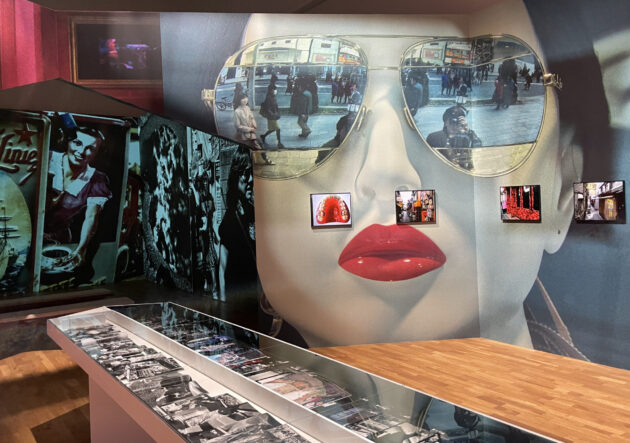
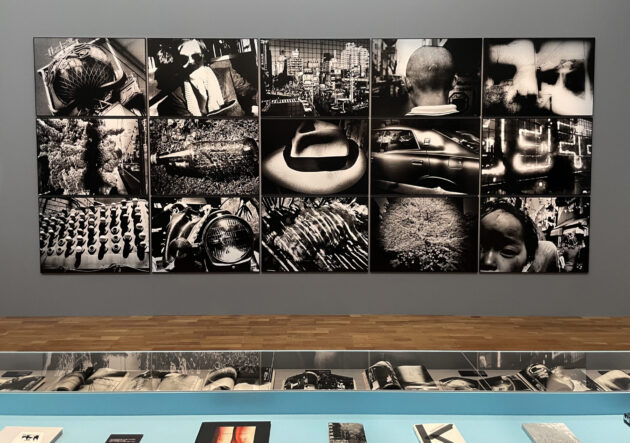
Kyotographie has established a tradition of presenting each year a stand-out retrospective of one of the world’s great photographers, notably including Graciela Iturbide and Irving Penn. 2026 brings a massive, career-spanning survey of the work of Moriyama Daido, arguably Japan’s most important post-war photographer and certainly the most influential. The bold scenography by Ouchi Osamu vies with and matches the content. The exhibition comprises four large, arrow-shaped rooms that propel viewers through the decades of Moriyama’s oeuvre.
The walls of each room are a single vibrant color, emphasizing the intensity of the photography while contrasting with its grainy monochrome. Tables with Moriyama’s decades of photobooks, magazines, and other publications run through the center of each space. Befitting the photographer’s breathless cropping and pacing, the walls are jam-packed with images showcasing his endless experimentation: shooting from the hip without use of the viewfinder and early attempts to present series of pure images, emancipated from text or notions of journalism. The structure of the exhibition leads viewers through the decades and then back through the same spaces to see the earlier work again in the context of his entire career.
Fatma Hassona — “The Eye of Gaza”
Although the festival is primarily a celebration of photography as art, another Kyotographie
tradition is the inclusion of journalism engaged with issues of war and peace, democracy and freedom. Kyotographie organized the “World Press Photo 2024 Kyoto” in the former printing press space of the Kyoto Shimbun newspaper and exhibited images from Iranian protestors in a collaboration with Le Monde. This year “The Eye of Gaza” documents the destruction of Gaza through the lens of Fatma Hassona, a young Palestinian photographer who was killed at the age of 25 in an Israeli attack on her home. Her images and voice are shared through the curation of Seideh Farsi who had been in communication with Hassona in the year before her death. The exhibition is held in the kura (traditional storehouse) of Hachiku-an, a beautifully preserved Taisho-era family house. Stepping through heavy sliding doors into the windowless space, viewers first encounter a theater-size projected slideshow of Hassona’s photographs of the streets, buildings, and people of a war-ravaged Gaza. The images are accompanied by a beautiful song in Arabic, sung and recorded by the photographer herself. A steep staircase leads to the pitch-black upper floor of the kura. At first only faintly glimpsed in the blackness is a single smartphone, floating at eye-level in the center of the room. The phone plays the recorded video-chats between Farsi and Hassona, a vivacious young woman speaking intimately about her passions and ambitions. This literal light in the darkness is a tiny window into Gaza, cut off from the world and inaccessible to international journalists, as well as a metaphor for the life of the photographer herself.
Yves Marchand & Romaine Meffre — “The Shape of What Remains”
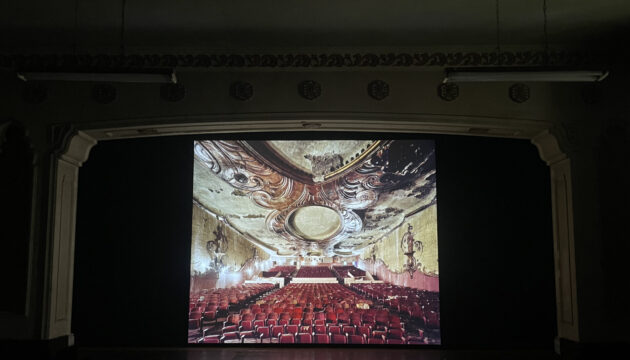
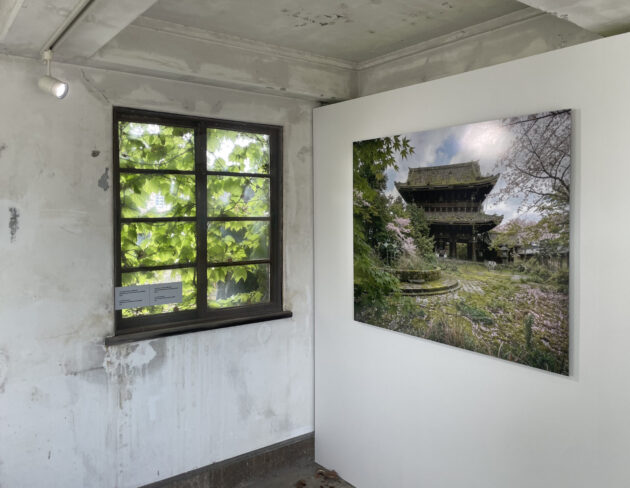
A powerful thematic rhyme within the festival is that of Fatma Hassona’s documentation of the ruins of Gaza and an exhibition of “modern ruins” by Yves Marchand and Romaine Meffre. “The Shape of What Remains” is staged in a literal ruin, a 1930s-era building which was a dormitory for the monks from the nearby Higashi Hongan-ji Temple. Large-scale images of once grand architectural spaces which have been abandoned to rot are displayed in the many rooms throughout the building’s four floors, as well on the rooftop. The first space is a small darkened theater, where a slideshow is projected on a screen within the proscenium. The images are themselves of theaters, ornate, temple-like spaces, now abandoned or repurposed, some decaying beautifully, others transformed into supermarkets, gyms, and the most magnificent parking garages in the world. From there viewers can wander the building, passing from room to room and up and down staircases. In the basement are photographs from Nagasaki prefecture’s Gunkanjima (literally Battleship Island), a once thriving and overcrowded coal mining community abandoned after the mine’s closure in the 1970s.
Another of Marchand and Meffre’s series presents the spectacle of the ruins of a forgotten Paris, created by combining new and archival photography with AI imagery. The process of their creation is itself part of the artwork as the walls of the rooms are also wallpapered with the many AI iterations and text prompts used in their creation and refinement. Though the photographs are works of fiction, viewers are forced to acknowledge that in our era, post-Covid and post-Chernobyl, an empty Paris or Tokyo is no longer unimaginable. On the rooftop, a small room houses images of an uninhabited Kyoto, but the effect is quite different from that of grand European palaces ravaged by time. Perhaps due to fatigue from overtourism, Sannen-zaka Street and Yasaka Pagoda seem quite natural, even peaceful in a world without humans.
The entire exhibition is held together by the subtle presence of a soundscape created by composer Yannick Paget. Each section of the building and corresponding series has its own instrumentation and theme. Original music, recorded in the building itself by N’SO, the Kyoto-based ensemble led by Paget, is blended with field recordings and plays throughout the exhibition: in the theater space, a euphonium and the faint whir of a vintage film projector; the staccato of a plucked cello for Gunkanjima; romantic clarinets in Paris; the chimes and bells of the Gion Festival ring out in abandoned Kyoto; all accompanied by haunting vocals.
The subject of abandoned spaces, a favorite of many a young art student, could easily fall into cliché and wistful romanticism, and arguably, Kyotographie is gilding the lily (a withering lily in this case) by displaying theaters within a theater and ruins within a ruin. That said, this thoughtful and beautiful exhibition works; The tightrope is successfully walked, with the space, scenography, music, and imagery all interacting symbiotically.
Juliette Agnel — “The Scent of Light”
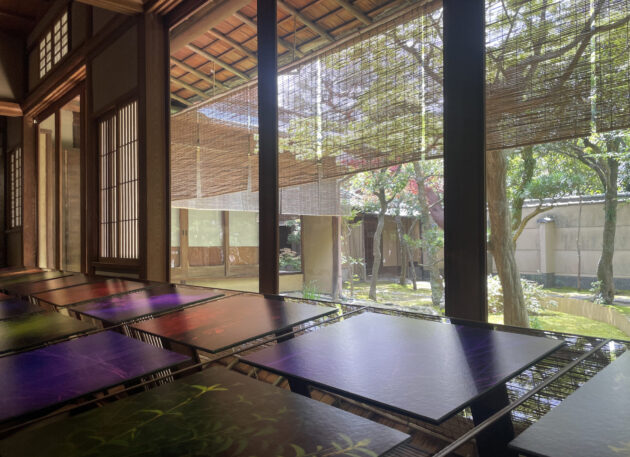
Across town, Juliette Agnel’s “The Scent of Light” is set in Yuuhisai Koudoukan, a large sukiya-zukuri style complex just west of the Imperial Palace Park. Wider, sunnier, and more open than Kyo-machiya style townhouses, it functioned as a school in the Edo period. After passing through the long, cobbled approach and red Kyotographie noren curtain, visitors enter the building and pass through a small tatami tearoom. A hand-held, black-and-white video is projected there into the tokonoma alcove. The Super 8 footage was shot in the forests of Yakushima Island only a few days before the exhibition.
The main exhibition space is the long shoin hall alongside the wide moss garden, partially obscured by wooden sudare screens. On one side of the hall, a shoji-style half-wall displays images from “The Susceptiblity of Rocks,” Agnel’s series of “portraits” of rocks and minerals. Each of the unique stone specimens was borrowed from the Sorbonne’s research collections and photographed in studio lighting against a vivid blue background, a color in conspicuous contrast with the traditional space and garden. The geologic forms each show individual personalities: a spikey pink or soft bubbly jade. Opposite this, images from her “Dahomy Spirit” series are displayed on low stands resting on the tatami and overlooking the garden. These atmospheric night photographs of plants from in a garden in Benin are also intensely and artificially colored. Agnel was inspired to create “Dahomy Spirit” in part by animistic Vodún (Voodoo) religion in Benin, which together with “The Susceptiblity of Rocks,” convey the mysterious power of the natural world by presenting flora as uncanny and the inorganic as animate. In so many Kyotographie exhibitions the space is an equal partner with the artwork, and here, through sensitive scenography, the initially jarring vibrancy of Agnel’s works finds a kind of balance with the traditional architecture and garden.
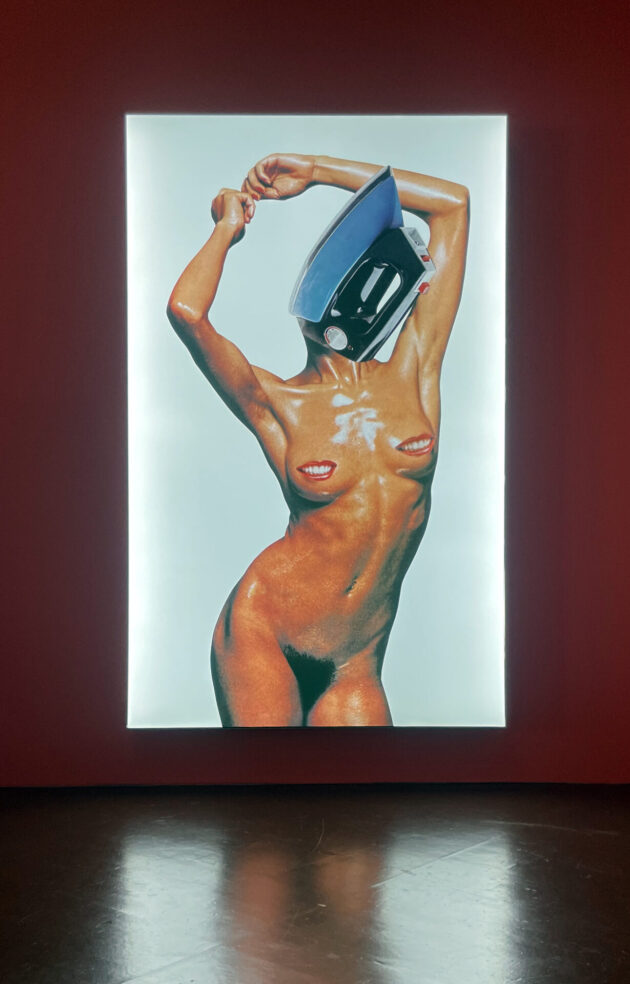
Linder Sterling — “Linder: Goddess of the Mind”
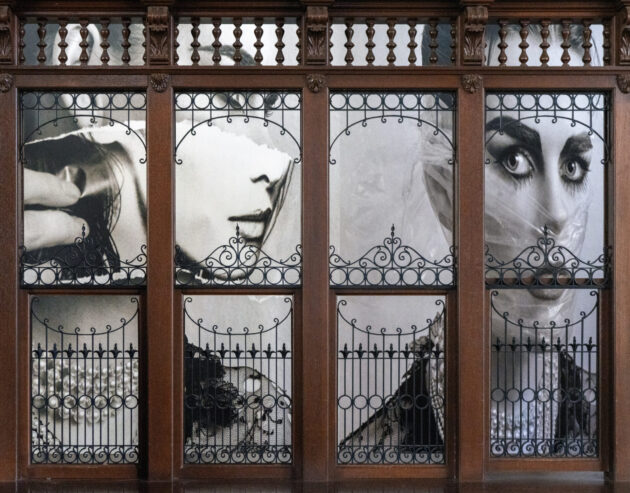
Bunka Hakubutsukan, The Kyoto Museum, has been a regular exhibition space for Kyotographie’s more cinematic highlights, including past exhibitions by Jean-Paul Goude, Pushpamala N, and Erwin Olaf. The Meiji-era building was originally the Bank of Japan’s Kyoto branch and some architectural elements reflect this history, notably the long teller counter running through the space. When first entering this year, the decorative wrought iron creates a beautiful frame for Linder Sterling’s giant wall sized prints. Linder: Goddess of the Mind presents 50 years of artwork playfully poking fun at the trappings of a materialistic and sexist bourgeoisie. Making use of an intense vermillion reminiscent of torii gates, Ishida Kentaro’s bold scenographic design bridges the charmingly conservative space with the artist’s punk energy.
Sterling’s mix of Dadaist, Pop Art, and Punk aesthetics have formal and thematic similarities to Andy Warhol—the use of repetition, subversion of portraiture, and fascination with low-brow pop culture and consumerism—but is more directly connected to the Weimar-era work of Claude Cahun and Hannah Höch, who similarly challenged mainstream gender roles and social structures. Like the collage art of female artists from an earlier generation, Sterling’s compositions are often simple and direct, almost crude. Using material from consumer magazines and pornography, purchased in those days only from sex shops, her collages show nude women in domestic spaces, their heads replaced with the implements of domesticity, record players, wall clocks, irons. One of nudes, featured as the cover for Buzzcock’s single “Orgasm Addict”, is printed larger than life, watching over the exhibition with its steam iron head and smiling breasts. Sterling’s is a darkly humorous take on gender roles, objectification, and beauty standards through the lens of 2nd wave feminism.
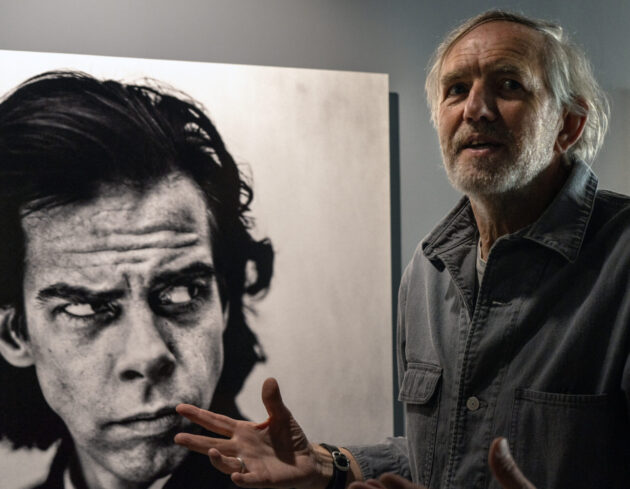
Anton Corbijn — “Presence”
Along with the retrospectives of Linder Sterling and Moriyama Daido, Anton Corbijn’s “Presence” collects 50 years of his celebrity photography. This surefire crowd-pleaser includes portraits of artists, musicians, actors, directors—from Anselm Keifer and Wim Wenders to Björk, Bowie, and (in another connection to South Africa) Nelson Mandela. Spanning the east and west wings of the Shimadai Gallery, the design of the exhibition is, for Kyotographie, relatively understated and simple; the traditional architecture and the gallery’s Japanese garden, while lovely, seem incidental. This, however, suits Corbijn’s own unpretentious style: direct, black and white, square format portraits using available light. Kyotographie founder, Lucille Reyboz, who started her own career as an album cover photographer for Blue Note Records, counts him as a mentor.
In addition to the main Kyotographie exhibitions, the satellite festival KG+ has grown bigger than ever with over 200 exhibitions this year! Even the most diehard photography enthusiast cannot hope to see them all. Among them however, we must single out the 12th annual “Shitsurai” exhibition at The Terminal KYOTO, curated by Kyoto Journal’s Founding Editor, John Einarsen, and featuring the work of several KJ contributors. Other highlights include two solo exhibitions by KJ contributors: Cindy Bissig’s “Beyond Sake” at Ace Hotel Kyoto and Daniel Sofer’s “Homage to Arashiyama” at Gallery Take Two.
We at Kyoto Journal deeply appreciate Kyotographie’s energy, creativity, and enthusiasm for the city. Each year they earnestly strive to share Kyoto with the world, to gather together great artists and musicians, to bring new energy to historic spaces, and to re-present Kyoto to itself as the rich, beautiful, and international cultural capital we love. A great Kyotographie exhibition is a delicate balance, a simultaneous harmony and tension, between the space and the subject which elevates both. In Kyoto City, the Kyotographie festival itself balances harmony and tension, continues to push limits, and retains its Edge.